
Mirroring the Self in Literature and Art
James A. W. Heffernan
The Routledge Companion to Literature and Art, ed. Neil Murphy, W. Michelle Wang, and Cheryl Julia Lee (New York: Taylor and Francis, 2023).
Anyone who studies either autobiography or self-portraiture knows that each of these two forms of self-representation has attracted a formidable number of critical studies. As I write these words in June of 2022, for instance, a quick check of the MLA online bibliography tells me that there are no less than 23,608 studies of autobiography. Staggering as it seems, this number pales by comparison with studies of self-portraiture, which--according to the online catalogue of the Getty Research Institute--top out at 76,567. But guess how many studies there are of autobiography and self-portraiture? So far as I can tell, the answer is precisely one--a dissertation written in 2005.1 What follows, then, should instantly double the scholarship on this strangely neglected topic.2
Let us examine it by means of mirrors. Most of us use them to look at our own reflected faces at least once a day, and for obvious reasons they furnish what is surely the best-known metaphor for imitation--or representation-- in literature and art. In the words that Shakespeare's Hamlet speaks to the players, we might say that all arts of representation--not just the theater--aim "to hold as 'twere the mirror up to nature" (Hamlet 3.2.20-21). When we turn our focus on visual art, this metaphor for imitation turns almost literal. According to Leon Battista Alberti, the most influential art theorist of the Italian Renaissance, art originated from the study of reflections. In Della Pictura (1435), his treatise on art, Alberti says that painting was invented by Narcissus, who fell in love with his own reflection in a shaded pool. "What else," writes Alberti, "can you call painting but a similar embracing with art of what is presented on the surface of the water in the fountain?" (Alberti, 64).
Alberti's rhetorical question prompts many more questions of a different kind. Quite apart from what we now know of pre-historic cave paintings, which depict animals rather than people (let alone narcissistic young men), Narcissus hardly seems to radiate the godlike power that Alberti imputes to ancient artists such as Zeuxis and all "master painter[s]" of any age (Alberti 64). Unlike them, Narcissus is not a maker of art but the dupe of his own reflection, which so entrances him that he dies of unrequited longing for it.
In the third century of our era, long before Alberti wrote his treatise, a Greek rhetorician named Philostratus defined Narcissus as a figure both powerless and paralyzed. Commenting on a painting that he saw while lodging in a seaside Neapolitan villa and that might have looked something like this Pompeian fresco (SLIDE 1), 
SLIDE 1. Narcissus. Pompeian fresco probably of the first century C.E.
Philostratus writes, "The pool paints Narcissus, and the painting represents both the pool and the whole story of Narcissus."3In other words, this might be called a metapicture, a painting about painting. But unlike Alberti, Philostratus does not consider Narcissus himself a painter. On the contrary, he sharply distinguishes Narcissus from the painter and--just as importantly--from the viewer of the painting that represents him. Directly addressing the painted young man, Philostratus says,
Narcissus, it is no painting that has deceived you, nor are you engrossed in a thing of pigments or wax; but you do not realize that the water represents you exactly as you are when you gaze upon it, nor do you see through the artifice of the pool, though to do so you have only to nod your head or change your expression or slightly move your hand, instead of standing in the same attitude; but acting as though you had met a companion, you wait for some move on his part. Do you then expect the pool to enter into conversation with you? Nay, this youth does not hear anything we say, but he is immersed, eyes and ears alike, in the water and we must interpret the painting for ourselves. (Philostratus, 91)
In this light, Narcissus makes a very strange model for the artist. Neither a maker of art nor an articulate viewer of it, he is simply and fatally immobilized by it. He has nothing to show or tell us about the process of representing anything, including himself, and nothing to say about the meaning of the painting or of the reflection it depicts--the painting within the painting. He leaves us to interpret the painting for ourselves.
Without further probing Philostratus' comments on a particular painting, let us grant that Alberti may simply be using the legend of Narcissus to define painting as an art of replication, of reproducing visible objects as accurately as possible. Just after calling Narcissus the inventor of painting, in fact, Alberti cites Quintilian--a professor of rhetoric in ancient Rome--as saying "that the ancient painters used to circumscribe shadows cast by the sun, and from this our art has grown" (Alberti, 64). Pliny the Elder thought likewise. In his Natural History of the first century of our era, Pliny claimed "there is universal agreement [sic] that [painting] began by the outlining of a man's shadow" (35.15): an event recalled in paintings such as this one (SLIDE 2):
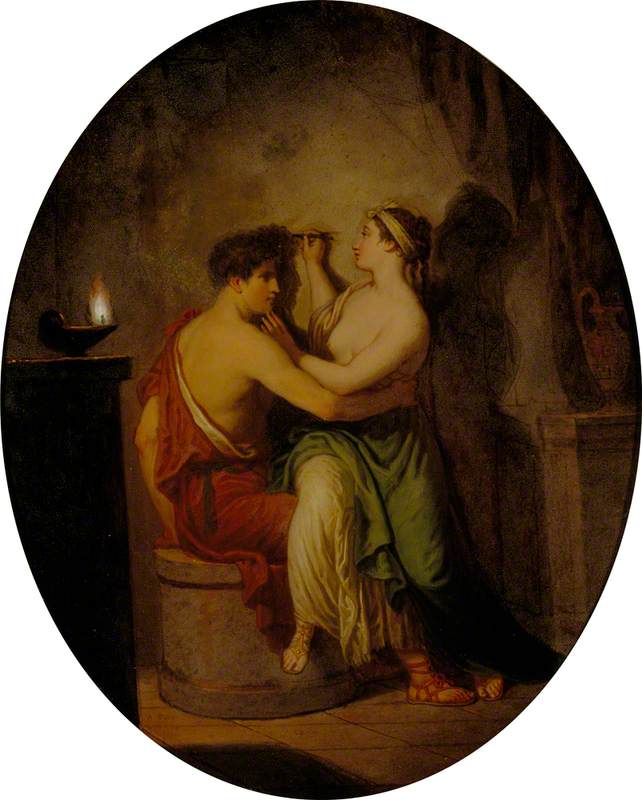
Slide 2. David Allan, The Origin of Painting (1775). National Galleries Scotland
But the legend of primal circumscription--whether or not it could ever be proven--hardly explains the origin of self-portraiture. For even with mirrors, it would be difficult if not impossible to trace the shadow of one's own profile without moving that profile and thus breaking the trace.
On the other hand, a painter can depict what he sees in the mirror, and many have done so. Before the invention of photography in the 1840s, the only way an artist could produce a recognizable likeness of himself was to paint his own reflection--"embracing (it) with art," as Alberti said. The act of doing so constitutes what I would call the ground level of self-representation, which is self-replication or self-duplication.
Take for instance this picture of himself that Rembrandt etched in 1648 (SLIDE 3):
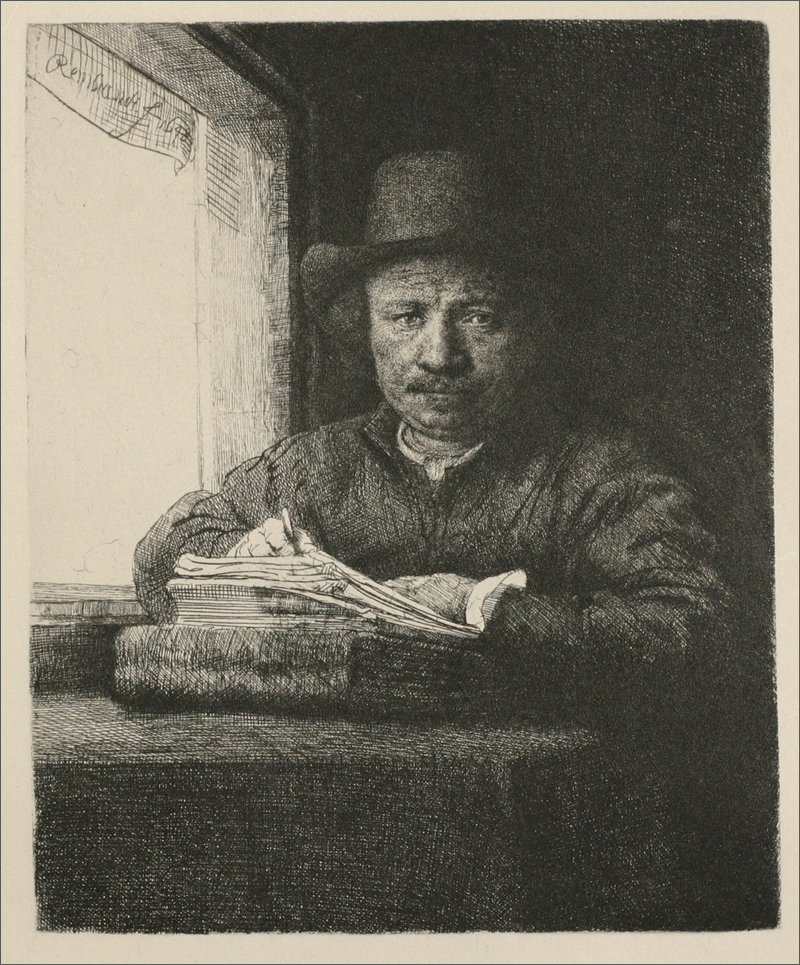
Rembrandt van Rijn, Self-Portrait Etching at a Window (1648). New York, Metropolitan Museum of Art. The Sylmaris Collection, Gift of George Coe Graves, 1920.
Here the 42-year-old artist delineates what he presumably sees in the mirror before him. Unadorned by any of the finery we so often see in his other self-portraits, uncolored by any of their flamboyance or dramatic flair, he sits at his table by a window practicing his craft as an etcher of pictures such as this. Here, according to H. Perry Chapman, a specialist in Rembrandt's self-portraits, Rembrandt "radically redefine [s] his self." Abandoning "the role of gentleman-virtuoso," he portrays himself "as an artist in the studio, autonomous in his professional identity. . . No longer play-acting, he sits at a table drawing probably with an etcher's needle on a plate. No longer elegantly costumed, he wears his mundane studio smock and a prosaic, middle-class hat, which brings to mind the 'freedom hat' widely used as a symbol of Dutch liberty in political allegories of the independence of the Netherlands. . . . . In 1648 the Treaty of Munster finally ended the war with Spain, bringing official recognition to Dutch independence. . . ." (Chapman 19-21).
Chapman's point is well taken. Rembrandt's simple hat and smock reinforce the authenticity of the picture as a window on a particular time of Rembrandt's life at a crucial year in Dutch history, and as a window on a particular moment of Rembrandt's working day: even the hour can be approximately gauged from the angle of the light slanting through the window. "This is just what the mirror reflected," writes Halla Beloff, a psychologist. "He is not dressed for an exotic never-land. The window places him mundanely in his house. The work is openly revealed, and so, we feel, is the artist. . . . What we see is a serious craftsman, indeed hard at work, a frown of concentration between his eyes. He examines himself. He is not interested in manipulating our view of him; he is not interested in us. . . . This is how he was" (Beloff in RbH, 31).
Relatively speaking, Chapman and Beloff are right. In the 1648 etching, Rembrandt represents his working life far more realistically than he does in a painting made about ten years earlier, where he poses as the Prodigal Son with his new wife Saskia (SLIDE 4):
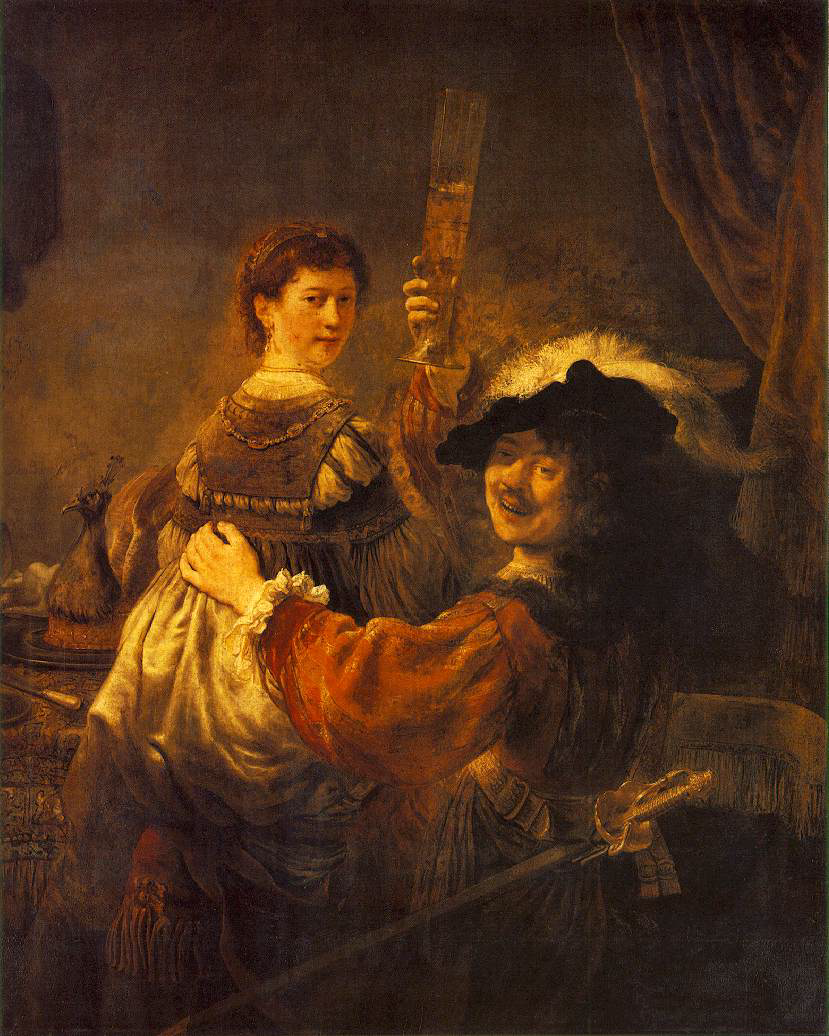
SLIDE 4. Rembrandt van Rijn, Rembrandt and Saskia in the Parable of the Prodigal Son (c. 1637). Dresden, Gemäldegalerie Alte Meister.
For all its play-acting, however, I suspect that as compared to the workaday etching, this painting more faithfully captures the spirit of Rembrandt's shirking life, the mood of gaiety and abandon with which he might well have celebrated his new marriage--especially at a time when his growing success gave him the means to do so. But leaving aside such speculation, look again at the etching. Is this exactly what the mirror reflected, as Beloff claims? The answer is no, not unless its reflections came only in black and white. In this respect, at least, the flagrantly theatrical painting is more realistic. If we resist that idea, it is only or chiefly because we associate the tonal sobriety of the print with understatement, with restraint, and therefore with honesty--the uncolored truth. But how much truth does a black-and-white etching tell about a colored reflection? How well does Rembrandt's rich chiaroscuro and delicate cross-hatching duplicate it? This is just one of the many questions raised by the claim that that any picture perfectly duplicates what the artist saw when he created it--in the mirror or anywhere else.
When Beloff claims that Rembrandt's etching is "just what the mirror reflected," we have absolutely no way of verifying this claim, no independent access to that mirror and not even any guarantee that he was looking at one. As we look at the etching, the eyes of Rembrandt look searchingly at something we cannot see, something outside the picture but so clearly occupying the place of the viewer that he seems to be looking at us. We find ourselves in this position whenever we look at a picture of the artist at work and facing us--as in Velazquez Las Meninas, painted in 1656, just a few years later than Rembrandt's etching (SLIDE 5):
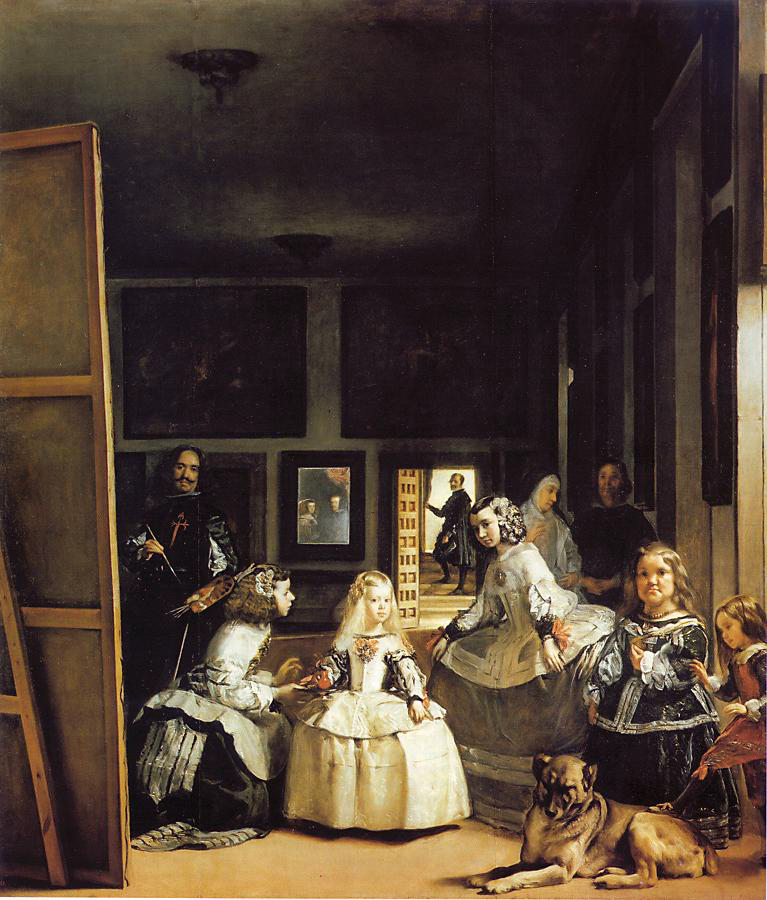
SLIDE 5. Diego Velázquez, Las Meninas (1656). Madrid, Museo Nacional del Prado.
In this painting of a painter at work beside his subjects, the back of the canvas blocks our view of whatever he is putting on it. The framed couple in the background hint at what he might be looking at--but only if we construe the couple as reflections in a mirror: reflections of a couple--the royal couple, in fact--occupying the place where we stand to view the painting. In that case, of course, what the painter sees before him and is shown to be depicting has almost nothing to do with the painting we see here. Even if we read the framed couple as a figures in a painting within the painting, and even if we imagine that the painter works before a mirror large enough to reflect everything that we now see in the painting, including himself, we cannot help occupying the space targeted by his gaze, and thus feeling that we occlude at least part of what the mirror reflects. In any case, the painting does not represent the painter in action--applying a brush to his canvas--but rather holding it steady, posing before a canvas we cannot see. To see his reflection in a mirror, the painter must look away from his canvas, just as the etcher must look away from his plate. He cannot simultaneously do his work and duplicate the mirror's reflection of his doing it.
If we now return to the 1648 etching (SLIDE 3), we see Rembrandt looking up from his plate. Do the compressed lips, the lowered double chin, the steady eyes, and the creased forehead express the mood of concentration with which he is working, or do they join to form just one more expression assumed for the mirror, taking its place with others such as this one of 1630 (SLIDE 6):

SLIDE 6. Rembrandt van Rijn, Self-Portrait with Beret (1630).
Here the pursed lips, the canted eyebrows, and the wide staring eyes seem theatrical or comic and hence unrealistic. But they seem unrealistic only if we believe--as G.E. Lessing once decreed--that visual art should represent nothing transitory, no fleeting expression (Lessing 20). They seem unrealistic only if we believe that the "real" Rembrandt--beneath and behind all that trumpery and posturing and mugging we see elsewhere--was the man limned in the 1648 etching: a man who habitually kept his mouth neatly shut, his brow tensed, and his gaze unwaveringly firm. Even if that were true, can we ignore the signs of artifice in this work? The window, for instance, not only gives the picture its artfully composed light but also reminds us of Alberti's master trope for painting: visible forms enclosed by a window frame (On Painting 64). Besides that, the strip of blind just below the top of the window shows us something Rembrandt could certainly not have seen in his mirror, for here he has signed his name and inscribed the date of the etching.
Do I labor the obvious here? It may seem so. It may seem needless to argue that no artist can ever duplicate what he or she sees in the mirror, and that in any case we have no independent access to what he or she might have seen there. But if these points are obvious and incontestable, I do not know what H. Perry Chapman means when she says that an artist posing before a mirror has abandoned play-acting, or what Halla Beloff means when she says that Rembrandt shows us "just what the mirror reflected." To study this etching is to see the impossibility of ever closing the gap between self and self-representation in visual art, between the artist who wields the brush or etching needle and the artist who poses, between a living body--even when reflected in the mirror--and a depicted or delineated one. I stress this point because a comparable gap separates the writing self from the written self in the literature of autobiography, whether fictionalized or not. Consider the opening stanza of the third canto of Childe Harold's Pilgrimage, Lord Byron's autobiographical travelogue in verse. Having written two cantos about his travels around the Mediterranean in 1810-11, when he was in his early twenties, he now records his embarkation from England in late April of 1816, two months after being decisively separated from his wife. He begins by apostrophizing their infant daughter Ada, who has been taken by his estranged wife and whom he will never see again:
		Is thy face like thy mother's, my fair child!
		Ada! sole daughter of my house and heart?
		When last I saw thy young blue eyes they smiled,
		And then we parted, --not as now we part,
		But with a hope.--
				Awaking with a start,
		The waters heave around me; and on high
		The winds heave up their voices: I depart,
		Whither I know not; but the hour's gone by,
		When Albion's lessening shores could grieve-or glad mine eye.
						CHP 3:1
We have here almost a picture made with words, a typographical image of separation. The stanza breaks precisely in the middle, graphically signifying two kinds of rupture: the wrenching separation of the speaker from his daughter, which assumes a painful finality when compared with a previous parting, and the sudden experience of waking up, which decisively breaks the mood of reverie established in the first half of the stanza.4 Yet even as it registers and represents rupture, the stanza demands to be seen and read as a whole. It begins and ends in a present tense that consumes nostalgia, that denies the emotional impact of the fissure between past and present, that defiantly asserts the speaker's indifference to the very act of parting: the sight of "Albion's lessening shores"--the dwindling coast of England--can no longer move him in any way.
The speaker's determination to deny the very split which this stanza so graphically reveals is reinforced by the mode of narration here. As Jerome McGann has said about the whole poem, the stanza makes "no distinction between the narrator's virtual present and a past series of events about which he writes."5 In the first four and a half lines, the speaker's reverie occurs at the very same time as his narration of it (McGann 34). But if we read Byron's stanza innocently, as if for the first time, we cannot know that its first four and a half lines express a mood of reverie until we learn that the speaker has been jolted awake. Only then are we asked to believe that the lines we have just read have not been uttered by an already awakened speaker, but rather have been spoken or somehow written within a dream. The second half of the stanza then implies something only a little less likely: that a dreamer could not only start speaking at the instant of awakening but also instantly transcribe his speech in verse, scribbling out a Spenserian stanza on the deck of a pitching ship. Byron thus exposes the illusion as such in the very act of generating it. Even as he tries to close the gap between the experiencing self and the writing self, between the dreaming voyager suddenly jolted awake and the poet deliberately shaping a stanza, he is forced to disclose it.
What is implied in this first stanza becomes explicit in the third, where the poet shifts to the past tense. Here he presents himself as the author of a poem about a gloomy, introverted, alienated wanderer named Childe Harold, the titular hero of the two cantos that Byron published in 1812, when he was 24:
	In my youth's summer I did sing of One,
	The wandering outlaw of his own dark mind;
	Again I seize the theme then but begun,
	And bear it with me, as the rushing wind
	Bears the cloud onwards: in that Tale I find
	The furrows of long thought, and dried-up tears,
	Which, ebbing, leave a sterile track behind,
	O'er which all heavily the journeying years
	Plod the last sands of life,--where not a flower appears.
						CHP 3.3
The I of this third stanza--the pronoun I-- clearly differs from the I of the first two. In the first two stanzas the voyaging narrator uses the present tense to tell the story of an actual embarkation, and of his reckless surrender to the elements: "I am as a weed," he says, "Flung from the rock, on Ocean's foam, to sail. " By contrast, the I of stanza 3 uses the past tense to say what he has written. So here the literal language used to record his physical embarkation becomes figurative; it figuratively signifies the renewal of composition. The man driven by wind and waves--the passive object of elemental forces--becomes himself a wind-like force driving his cloudlike theme along. Finally, the poet represents himself as also a reader--a reader looking back on a text that becomes a sterile tract of sand, a parody of the voyager's wake, even as he sets out to write again.
Before Harold reappears in the poem, therefore, Byron represents himself as an I with two selves: the speaking self of the narrating traveler, who is literally in motion and who immediately translates his experience into words, and the writing self of the dramatized poet, the poet who can read what he has written and comment on his own act of writing. Both selves persevere to the end of the poem.
Nevertheless, the dramatized poet never assumes the importance of the narrating traveler. Instead, he periodically dissolves into the traveler, as in this stanza from the latter part of canto 3:
	But let me quit man's works, again to read
	His Maker's, spread around me, and suspend
	This page, which from my reveries I feed
	Until it seems prolonging without end.
	The clouds above me to the white Alps tend,
	And I must pierce them, and survey whate'er
	May be permitted, as my steps I bend
	To their most great and growing region, where
	The earth to her embrace compels the powers of air.
						CHP 3.109
The I of this stanza first signifies the dramatized poet who has been reading "man's works" (the books of Rousseau, Voltaire, and Gibbon) as well as writing his own poem, endlessly feeding "this page." But in suspending this page, in lifting his pen from the paper he has been writing on, the dramatized poet once more becomes the narrating traveler. Writing as if he were speaking, reading the book of` nature instead of man-made texts, bending his steps to the Alps, he is literally on the move again.
First and last, then, Byron represents himself as a quester: a traveling narrator projected by the dramatized poet who also projects--but ultimately rejects--Childe Harold. What remains is the quintessentially Byronic pilgrim, a man with neither a determinate self nor a determinate destination, a personality in the act of perpetually becoming.
Byron's poem thus exemplifies two features common to self-representation in art as well as in literature: first, the impossibility of replicating one's life at any moment, reflecting it perfectly, exactly reproducing a mirror image of it; second, the inevitability of self-projection, self-dramatization, playing a role. Besides Harold, the title character, we have the dramatized poet and the traveling narrator, the highly self-conscious creator and the wandering self--the wandering I and eye--that he creates. Since the word personality springs from the Latin word for mask (persona), we might treat both of these personalities as masks for Byron's "real" self. But to think we can find his real self by stripping away the masks of the poem is like imagining that we can find the real Rembrandt by stripping off all of his costumes, rejecting all of his poses, dismissing all of the ways in which he depicts himself. Difficult as it may be to grapple with the trio of selves that Byron generates in CHP, doing so may help us to grapple with the daunting number of self-portraits painted and drawn by Rembrandt--more than ninety in all.
"Why so many?" is the question repeatedly asked. According to some art historians, Rembrandt's self-portraits served to advertise his virtuosity, his social status, and the dignity of painting itself (Wetering 12, Chapman 13). But there's a problem with this formulation: only a small number of his self-portraits cast him in a truly dignified light. Besides posing as a plumed young dandy in 1629 (SLIDE 7) and a luxuriantly sleeved grandee in 1639 (SLIDE 8), he also cast himself as an ugly beggar (SLIDE 9) and a screaming lout (SLIDE 10):

SLIDE 7. Rembrandt van Rijn, Self-Portrait Age 23. Boston, Isabella Stuart Gardner Museum.
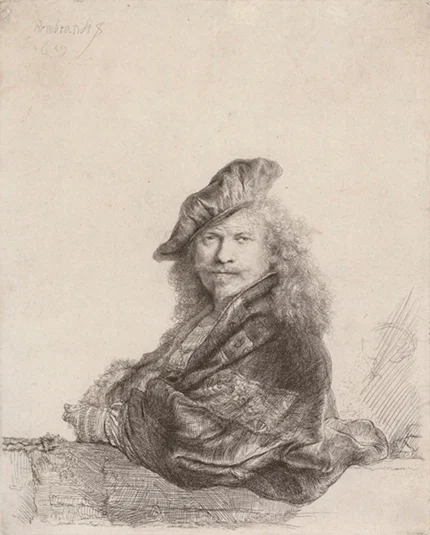
SLIDE 8. Rembrandt van Rijn, Self-Portrait Leaning on a Stone Sill. Etching (1639). Prague, National Gallery.
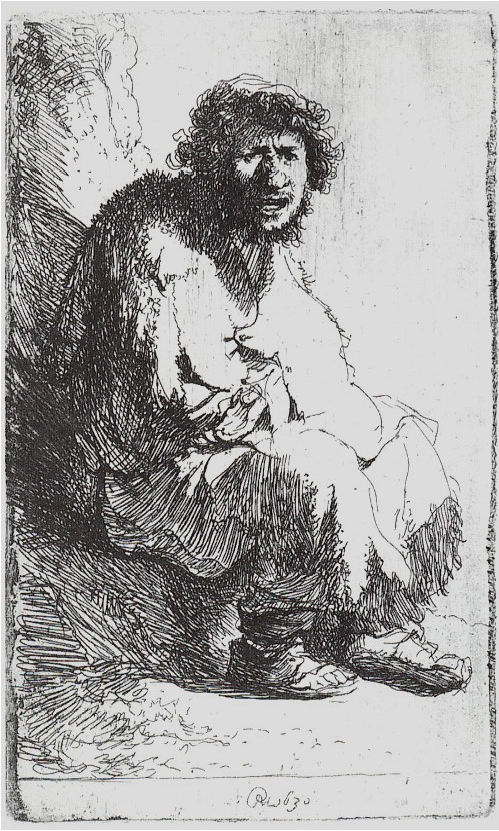
SLIDE 9. Rembrandt van Rijn, Beggar Seated on a Bank (1630). Etching. Princeton University Art Museum.
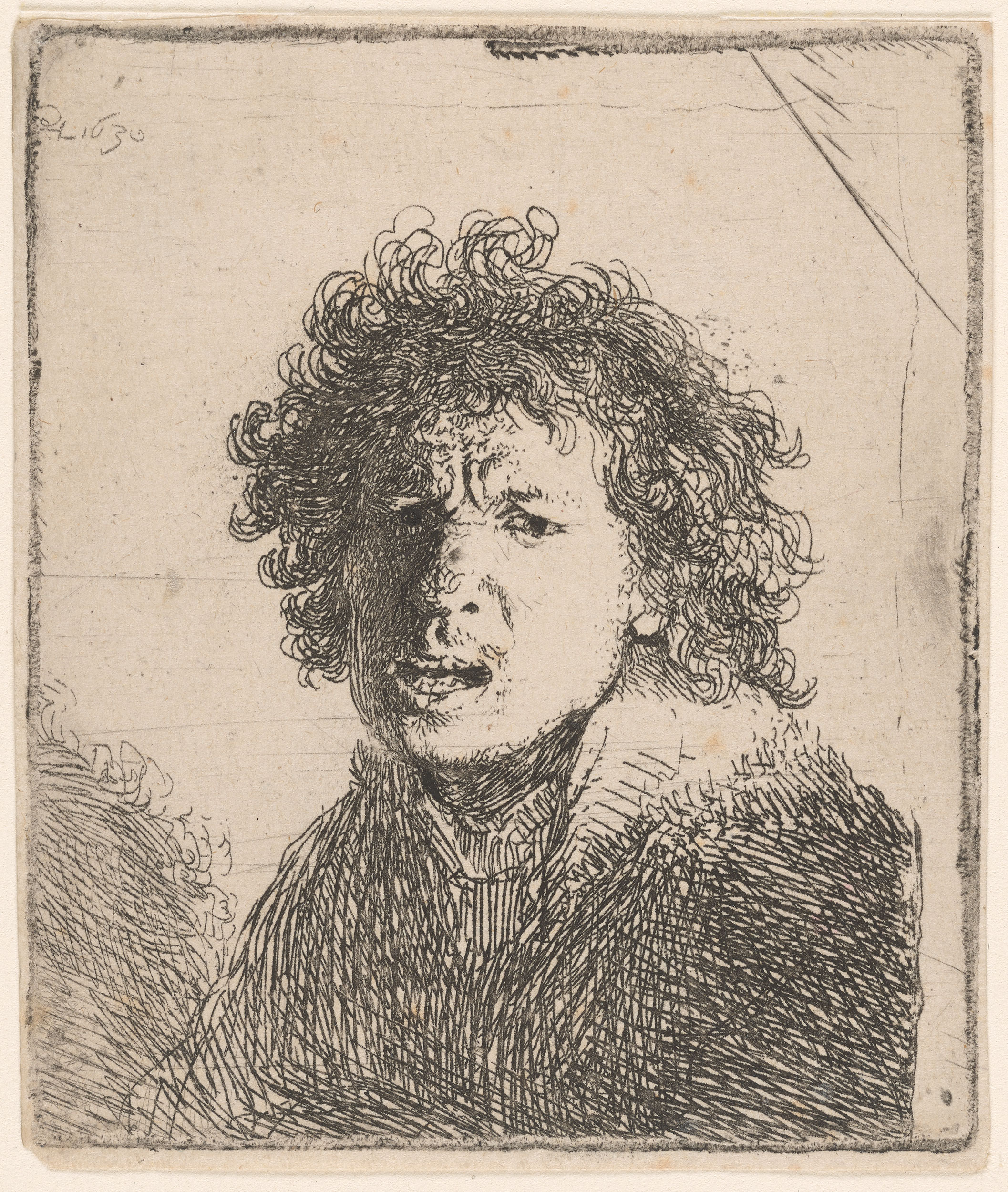
SLIDE 10. Rembrandt van Rijn, Self-Portrait Open Mouthed, as if Shouting (1630). Etching on laid paper. Washington, DC: National Gallery.
Once again, why so many self-portraits? Let me answer in two stages. The dazzling variety of ways in which Rembrandt represents himself springs in part from something as universal as self-presentation in everyday life, the title of a 1959 book by Erving Goffman that is cited by Halla Beloff. Summarizing Goffman's argument, Beloff writes that in everyday life we are all more or less acting, that "we perform our parts to communicate as best we can the vision of our personal autobiography and our social status" (Beloff 25). In other words, in the selves we present to others--in the faces we prepare to meet the faces we shall meet, as Eliot's Prufrock says--we strive to fuse what we think of ourselves with what we want other people to think of us. But the fusion is seldom perfect, and social pressure leads instead to a multiplicity of roles. In his autobiographical Confessions (written in the late 1760s), Jean-Jacques Rousseau recalls that his childhood reading of Greek and Roman heroes fired his imagination so much that he "believed himself to be Greek or Roman; I became the character whose life I read." (Rousseau 8). Later on, recalling one of the many long walking trips he took as a young man, he writes of finding his true self in solitude on the road: "Never have I thought so much, existed so much, lived so much, been myself so much, if I dare speak this way, as in these travels I have made alone and on foot" (Rousseau 136, emphasis mine). But if we conclude that Rousseau's true self lies in solitary walking, how do we explain what he suddenly felt in his youth while posing as an English Jacobite among a group of French Catholics that he met in his travels? During the course of an evening walk with one of them, a charming older woman, his tongue-tied embarrassment and gnawing fear of exposure were suddenly vanquished when she put her arm around his neck and kissed him. "The crisis," he writes, "could not have happened more opportunely. I became lovable. It was time for it. She had given me that confidence the lack of which has almost always kept me from being myself. I was so at the time. Never have my eyes, my senses, my heart and my mouth spoken so well." (Rousseau 211). I was myself, says Rousseau, at the very moment when I was posing as someone else. Here the inner self--the would-be soul of the individual--merges with the social self. To see that Rousseau suddenly discovers himself--or a self--even while masquerading as an Englishman and playing the role of a glib lover is to see how much other people can shape our conception of ourselves.
Writers and artists know this only too well. Once they acquire a reputation, they must accommodate a public self along with the private one. In a little essay by Jorge Luis Borges called simply "Borges and I," the famous Argentinian writes:
It is to the other man, to Borges, that things happen. . . . of Borges I get news through the mail and glimpse his name among a committee of professors or in a dictionary of biography. I have a taste for hourglasses, maps, eighteenth-century typography, the roots of words, the smell of coffee, and Stevenson's prose; the other man shares these likes, but in a showy way that turns them into stagy mannerisms.
Inevitably, it seems, Borges deploys the language of theater to represent his public self, but then he candidly concludes, "Which of us is writing this page I don't know." (Borges 279).
Turning back from Borges to Rembrandt, then, we might first explain the astonishing variety of his self-portraits by observing that artists and writers alike continually engage in a heightened version of everyday self-presentation, of the acting we do with each other to shape our personalities for social ends. But when Rembrandt etches himself as an ugly beggar or a screaming lout, what social advantage does he gain? Looking elsewhere for his motives, we must surely recognize that Rembrandt drew and painted his pictures almost as if staging a play: that he chose his sets, costumes, and lighting for theatrical effect, and that he used himself--his own face and body--to explore the expressive possibilities of art, its capacity to represent what Alberti called "the movement of [the] soul" in each of its figures (On Painting 77). In drawing himself as a screaming lout, is he representing a personal moment of anguish or preparing himself to paint the agonized face of Christ on the cross, as he did in 1631? (SLIDES 11, 11A)

SLIDE 11. Rembrandt van Rijn, Christ on the Cross (1631). Le Mas-d'Agenais, Lot-et-Garonne, église Saint-Vincent.
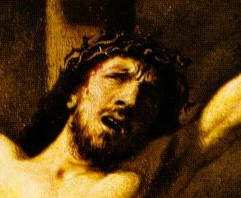
SLIDE 11A. Rembrandt, Christ on the Cross, detail.
Whether posing as himself or as someone else, such as the Prodigal Son, Rembrandt could not pose at all without playing a role, but always a role that expressed some fraction of his identity as an artist and thereby shaped the self he was presenting. Rousseau begins his Confessions with the potent words, "je forme." "I am forming, I am shaping," he writes, the inimitable and unprecedented story of myself. It will include the shameful as well as the noble, he promises, and he does indeed confess to such things as exposing himself to young women in dark alleys, abandoning a friend in need, and falsely accusing a servant girl of a theft that he himself committed. Nevertheless, Rousseau forms and shapes his narrative to contrapose the best and worst features of his character, and to highlight the crucial stages of his life, as when Book I ends with his fateful departure from Geneva at the age of sixteen.
Does this mean that Rembrandt likewise shapes the story of his life in his self-portraits? I venture to say no. The familiar claim that Rembrandt's self-portraits add up to an autobiography simply will not survive close scrutiny, especially when we compare them to the more or less coherent and comprehensive narratives wrought by literary autobiographers such as Rousseau. The portraits do indeed show Rembrandt growing older: from the round, smooth face of youthful intensity and shadowed, penetrating eyes (SLIDE 12)
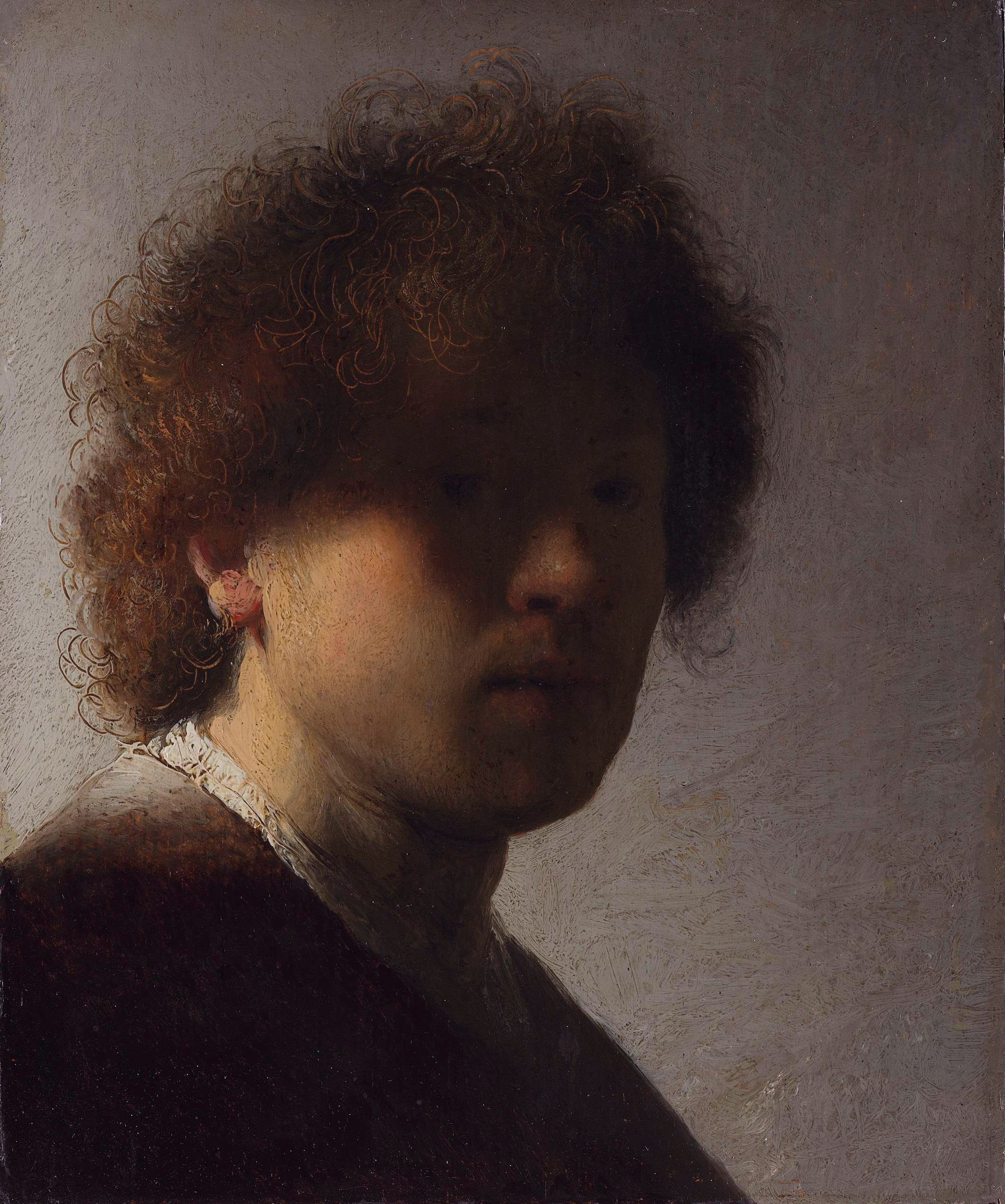
SLIDE 12. Rembrandt van Rijn, Self-Portrait as a Young Man (1628-29). Amsterdam, Rijksmuseum.
Wendorf, Richard. Sir Joshua Reynolds: The Painter in Society.
Cambridge, MA: Harvard UP, 1996.